Karachi: The Karachi Chamber of Commerce & Industry (KCCI) and the Federal Insurance Ombudsman (FIO) have agreed to strengthen institutional collaboration to facilitate the business community through faster resolution of insurance-related disputes, improved regulatory coordination, and enhanced awareness of policyholders’ rights.
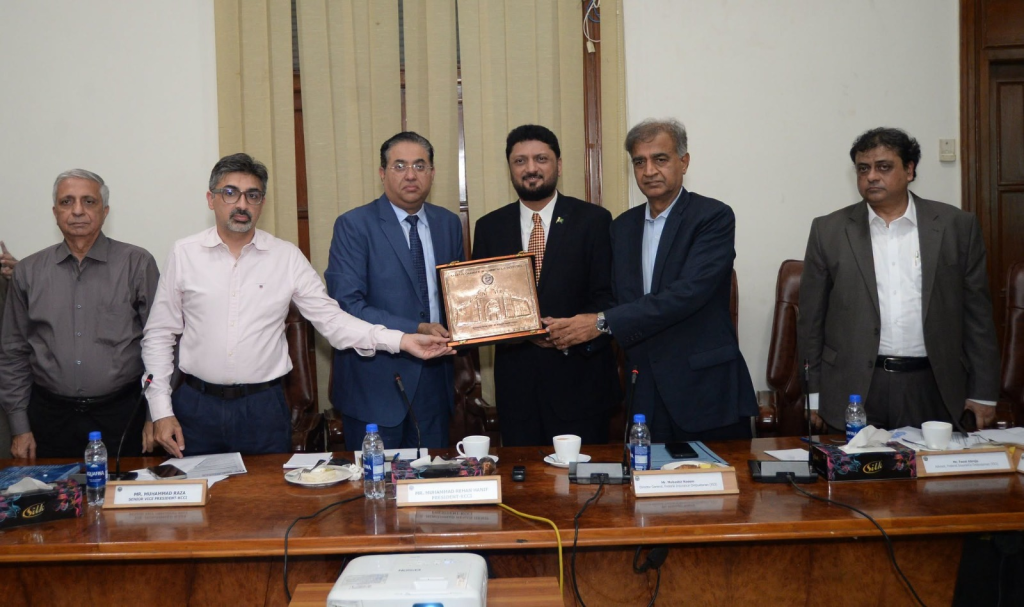
The understanding was reached during a meeting at the KCCI, where Director General, Federal Insurance Ombudsman, Mobashir Naeem Siddiqui, accompanied by Advisor FIO Fazal Abrejo, held discussions with KCCI President Rehan Hanif, Senior Vice President Muhammad Raza, Vice President Muhammad Arif Lakhani, Chairman of KCCI’s Banking & Insurance Subcommittee Asim Aejaz, and members of the Executive Committee.
Addressing the meeting, Mobashir Naeem Siddiqui acknowledged concerns raised by the business community regarding trade insurance and reinsurance amid prevailing regional security challenges. He noted that geopolitical uncertainty has increased reinsurance costs, resulting in higher insurance premiums and coverage challenges for businesses engaged in international trade. He expressed optimism that conditions would improve as regional stability returns.
To address industry concerns, Siddiqui proposed a dedicated consultative session involving the KCCI, the Federal Insurance Ombudsman Secretariat, and the Securities and Exchange Commission of Pakistan (SECP). He also suggested establishing a joint committee comprising representatives of the three institutions to examine policy issues, recommend regulatory improvements, and resolve sector-specific challenges on a priority basis.
Highlighting the role of the Federal Insurance Ombudsman, Siddiqui said the institution serves as an independent Alternative Dispute Resolution (ADR) forum established under the Insurance Ordinance, 2000, and the Federal Ombudsmen Institutional Reforms Act, 2013, providing free, impartial, and expeditious resolution of insurance disputes.
He informed participants that individuals, companies, and policyholders could approach the Ombudsman without legal representation, adding that nearly 95 percent of complaints are resolved within 60 days, while more than 90 percent are settled amicably through mediation and arbitration. He further noted that the FIO Secretariat facilitated financial relief exceeding Rs1.5 billion during the previous year by resolving delayed and disputed insurance claims.
Siddiqui also outlined recent consumer protection initiatives undertaken in collaboration with the SECP, including the introduction of bilingual insurance policy documents in Urdu and English and the inclusion of the Ombudsman’s contact details on policy documents to improve public access to dispute resolution services.
To strengthen engagement with the business community, he proposed the nomination of a dedicated KCCI focal person to establish a virtual liaison desk for the prompt handling of members’ insurance-related grievances. He also offered to organize regular awareness seminars, technical briefings, and capacity-building programmes for KCCI members, while announcing that the FIO Secretariat would share awareness material for dissemination through KCCI’s digital platforms. Representatives of KCCI’s Social Media and Banking & Insurance Subcommittees were also invited to participate in the Secretariat’s monthly awareness meetings to enhance information sharing and institutional coordination.
Speaking on the occasion, KCCI President Rehan Hanif welcomed the visiting delegation and appreciated the Federal Insurance Ombudsman Secretariat’s contribution to protecting policyholders’ rights and strengthening confidence in Pakistan’s insurance sector.
He emphasized that a transparent, efficient, and reliable insurance system is essential for promoting investment, facilitating trade, managing commercial risks, and supporting sustainable economic growth. He also underscored the importance of an independent institution capable of resolving insurance disputes fairly and expeditiously.
Rehan Hanif noted Karachi’s pivotal contribution to the national economy through trade, industry, exports, and tax revenues, stressing that while the business community remains committed to regulatory compliance, the regulatory framework must remain predictable, business-friendly, and facilitative.
Highlighting concerns raised by KCCI members, he called for greater regulatory clarity, improved coordination among regulatory institutions, timely resolution of compliance-related matters, and increased awareness of evolving legal and regulatory requirements.
He assured the FIO Secretariat of KCCI’s full support in organizing awareness programmes, training sessions, and consultative engagements aimed at educating businesses on insurance matters while enabling regulators to better understand the operational challenges faced by the private sector.
Both sides expressed confidence that closer collaboration between KCCI and the Federal Insurance Ombudsman Secretariat would improve access to justice for policyholders, strengthen confidence in the insurance sector, and contribute to a more transparent, resilient, and business-friendly economic environment in Pakistan.